
.svg)
.svg)
.svg)
.svg)



How to Plan a Mid-Week Manor House Wedding in 2026
Most couples start their search on a Saturday in peak season, find out what that costs, and start again. This guide is for the second search. It covers what a mid-week wedding saves, what it asks of your guests, and what to check before booking a manor house for a Tuesday in June.
We host around 130 events a year at Clevedon Hall, a good number of them mid-week, so most of what follows comes from watching couples weigh up the same decision.
What the day of the week is worth
The national picture first. Bridebook's 2026 UK Wedding Report, drawn from more than 7,000 couples, puts the average UK wedding at £20,604 excluding the ring and honeymoon. Hitched's 2026 report, based on 2,020 newlyweds, puts it at £21,990. Neither figure describes your wedding. Both are useful as a sanity check, and both show the same shift: guest lists are shrinking while spend per head rises. Hitched has that at £272 a guest, up 4% on the previous year.
The day of the week moves the total more than most couples expect. CompareWeddingInsurance.org.uk analysed weddings booked between 2024 and 2028 and found Saturdays running about 10% above the average and Mondays about 20% below, a spread of more than £5,000.
Two caveats.
The first is theirs. That gap does not mean you can move a Saturday to a Monday and pocket five thousand pounds. Couples who choose a weekday are often planning a different sort of celebration to begin with, frequently a smaller one. The correlation is real. The saving is not automatic.
The second is that mid-week is no longer unusual, so the discount is no longer extreme. The same analysis found Saturday accounted for roughly 55% of weddings a decade ago and under half now. Venues have noticed. The deep mid-week discounts of a few years ago are harder to find, though most still price Monday to Thursday below Saturday, usually by 15% to 30%.
Where the saving comes from, and where it does not
A good deal of published advice implies that everything gets cheaper on a Wednesday. It does not.
Venue hire is where the difference sits. Catering usually does not move, because food costs what it costs whatever the date. Photographers, florists and bands may discount a weekday, and many will, but that is a negotiation rather than a published rate.
Statutory costs often do not move at all. In North Somerset the registrar's attendance fee at approved premises is £570 for a classic ceremony on any day from Monday to Saturday, rising to £630 on Sundays and £750 on bank holidays. Notice of marriage is £42 per person. A Tuesday wedding here saves you nothing on the registrar. Fees vary a lot between councils, so check your own registration district, but the general point holds. The venue is the lever, not the paperwork.
So ask any venue for their mid-week rate and their Saturday rate for the same month, in writing, with the same inclusions. Comparing a mid-week package against a Saturday package with a different guest minimum is how couples end up disappointed.
One thing to check on any pricing page, ours included. Where a venue publishes a hire figure, find out which day it applies to. Ours, set out below, are mid-week rates. Plenty of venues publish a weekend rate, or a single figure with the day left unstated, and the comparison falls apart unless you ask. Ask for the minimum food and beverage spend at the same time. On an exclusive-use booking that is usually the larger of the two numbers.
The trade-off is your guest list
This is the part that decides most mid-week weddings.
Guests in full-time work will need to use annual leave. Guests with school-age children have a harder problem, since children cannot be taken out of school for the day, and mid-week childcare is not always available for those coming without them. Rock My Wedding's guide to weekday weddings puts it plainly: expect a few more declines than you would for a Saturday.
There is a second effect that is easy to miss. Mid-week celebrations tend to finish earlier. Guests who have taken one day off, or who have a school run in the morning, leave sooner than they would on a Saturday night. If the late part of the evening matters to you, plan for it rather than hope.
Four things make a real difference to attendance.
Give people as much notice as you can. Coco Wedding Venues suggests that with at least twelve months most guests can arrange their lives around the date, and that matches what we see. Save the dates for a mid-week wedding should go out earlier than for a Saturday, not later.
Choose a day that leans against a weekend. A Monday or a Friday turns one day of leave into a long weekend. A Thursday lets guests take the Friday as well and travel home on Saturday.
Consider school holidays. They remove the childcare problem for a large part of your list, though they push up the cost of guest travel and accommodation.
Offer accommodation on site. This is the single biggest change you can make to how a mid-week wedding feels for the people attending, and it is where a manor house with bedrooms behaves very differently from a hotel function room.
Why exclusive use changes the arithmetic
Mid-week availability and exclusive use tend to arrive together. A venue that lets the whole house will often take one weekend wedding and one mid-week wedding in a given week, so the mid-week date is frequently the one with flexibility attached: earlier access, a later finish, a second night.
The second night is the point. A wedding that starts on the Monday evening and ends after breakfast on Wednesday asks for two days of leave rather than one, which sounds like a harder request and is often an easier one. Guests who were going to drive an hour each way, book a room somewhere and leave before the evening finished instead unpack once. Older relatives are already in the building. Nobody is driving.
It changes what your guests spend, too. A room at the venue, often at a rate held for the wedding party, tends to compare well against a hotel plus taxis, and it removes the conversation about who is driving home.
At Clevedon Hall there are 25 bedrooms in the house and a cottage in the grounds, and a wedding party takes the whole building. On double occupancy that is 50 adults sleeping on site, rising to 65 with the pull-out beds, which is usually how families with children end up arranged. The cottage sleeps a further eight. For a guest list of a hundred, half or more of your guests have no travel problem at all, and those tend to be the half who would most struggle with a weekday.
One detail to check with us, because it changes with the season. In high season, May to September, 25 bedrooms with breakfast are included in the hire. In the low and super off peak months it is 15. The remaining rooms are available in those months but sit outside the included allocation, so ask about your specific date.
Manor house planning considerations
A listed Victorian house is not a blank space. Clevedon Hall dates from 1853 and is Grade II* listed, and most listed country houses carry similar restrictions. Things to ask about:
Fixings and decoration. Listed interiors usually limit what can be attached to walls, panelling and ceilings. Ask what your florist may hang and from where, then put your florist and the venue in touch directly rather than relaying messages between them.
Candles and naked flames. Often restricted, sometimes not permitted at all. Ask before you plan a candlelit aisle.
Outdoor ceremonies. Since April 2022, civil ceremonies in England and Wales may take place outdoors in the linked outdoor areas of approved premises, which is why so many country houses now offer garden ceremonies. Check that the spot you want sits inside the venue's approval, and ask about the wet weather alternative and how late the decision can be made.
Access. Gravel, steps and period thresholds matter if you have guests with limited mobility. Ask for the actual route rather than a reassurance. Clevedon Hall has a lift and one fully accessible bedroom.
Sound and finish times. Old houses in residential settings often have conditions attached to their premises licence, and those conditions can differ mid-week. Ask what time music must stop, and whether the answer is the same on a Tuesday as on a Saturday. Music here finishes at midnight, with options to extend, and that does not change because you have chosen a weekday. The building will not turn you out early. Your guests may still leave earlier than they would on a Saturday, which is a different problem and a real one.
Supplier access. If the house is yours from the previous afternoon, suppliers can set up properly instead of rushing on the morning. Worth asking about, since a venue turning around from a Saturday wedding cannot always offer it.
Heating and season. A large period house in February is a different proposition to the same house in July. The best value usually sits in an off-peak mid-week date, so visit in the season you intend to marry in.
The order things happen in
Choose and secure the venue first. You have to name it when you give notice, and you cannot give notice more than twelve months before the ceremony.
Book the registrar directly with the register office for the district the venue sits in. That is separate from booking the venue, and popular slots go early. Do not assume the venue has done it for you.
Give notice at the register office where you live, at least 29 days before the ceremony. Both of you must have lived in your district for the previous seven days.
Then send save the dates, early.
Bridebook's 2026 report found that 79% of couples book their venue within four weeks of first enquiring. That sounds fast until you realise most are choosing between two or three places they have actually stood in. See fewer venues properly rather than more of them briefly.
Is a mid-week wedding right for you?
It probably works if your guest list is largely adult, if a good number of your key people can stay on site, if you would rather spend the money on food and photography than on the day of the week, or if the venue you want has nothing on a Saturday for two years and a Tuesday next spring.
It probably does not work if a large part of your list has school-age children and cannot travel, if several key people are shift workers or self-employed in ways that make a weekday expensive for them, or if a long evening with everyone still dancing at midnight is the thing you care most about.
Neither answer is better. They are different weddings.
Frequently asked questions
How much does a mid-week wedding save in the UK?Most venues price Monday to Thursday somewhere between 15% and 30% below Saturday. Analysis of weddings booked for 2024 to 2028 found Mondays running about 20% below the overall average and Saturdays about 10% above, though part of that gap reflects couples planning smaller celebrations rather than the day of the week alone.
Do registrars charge less mid-week?Not necessarily. In North Somerset the attendance fee at approved premises is the same from Monday to Saturday. Sundays and bank holidays cost more. Fees are set by each council, so check your own registration district.
Will guests come to a weekday wedding?Most of the people who matter will, given enough notice. Expect a slightly higher decline rate than a Saturday, particularly among guests with school-age children. Twelve months of notice, a day next to a weekend, and accommodation on site all help.
Can we get married outside at a manor house?Yes, at approved premises in England and Wales, provided the spot sits within the venue's approved outdoor area. This has been permitted since April 2022. Always ask about the wet weather alternative.
What does a mid-week manor house wedding cost?As a worked example, exclusive-use hire at Clevedon Hall starts at £5,500 mid-week in January and February, £7,600 in the low season months of March, April, October, November and December, and £9,650 from May to September. Minimum food and beverage spends apply on top and vary with guest numbers. Other exclusive-use houses will differ, but the shape is usually the same. Hire is seasonal first and day-of-week second.
How far ahead should we book?Mid-week dates are usually available at shorter notice than Saturdays, sometimes within a year. You cannot give legal notice more than twelve months before the ceremony, so that is the floor for the paperwork rather than for the venue.
Mid-week at Clevedon Hall
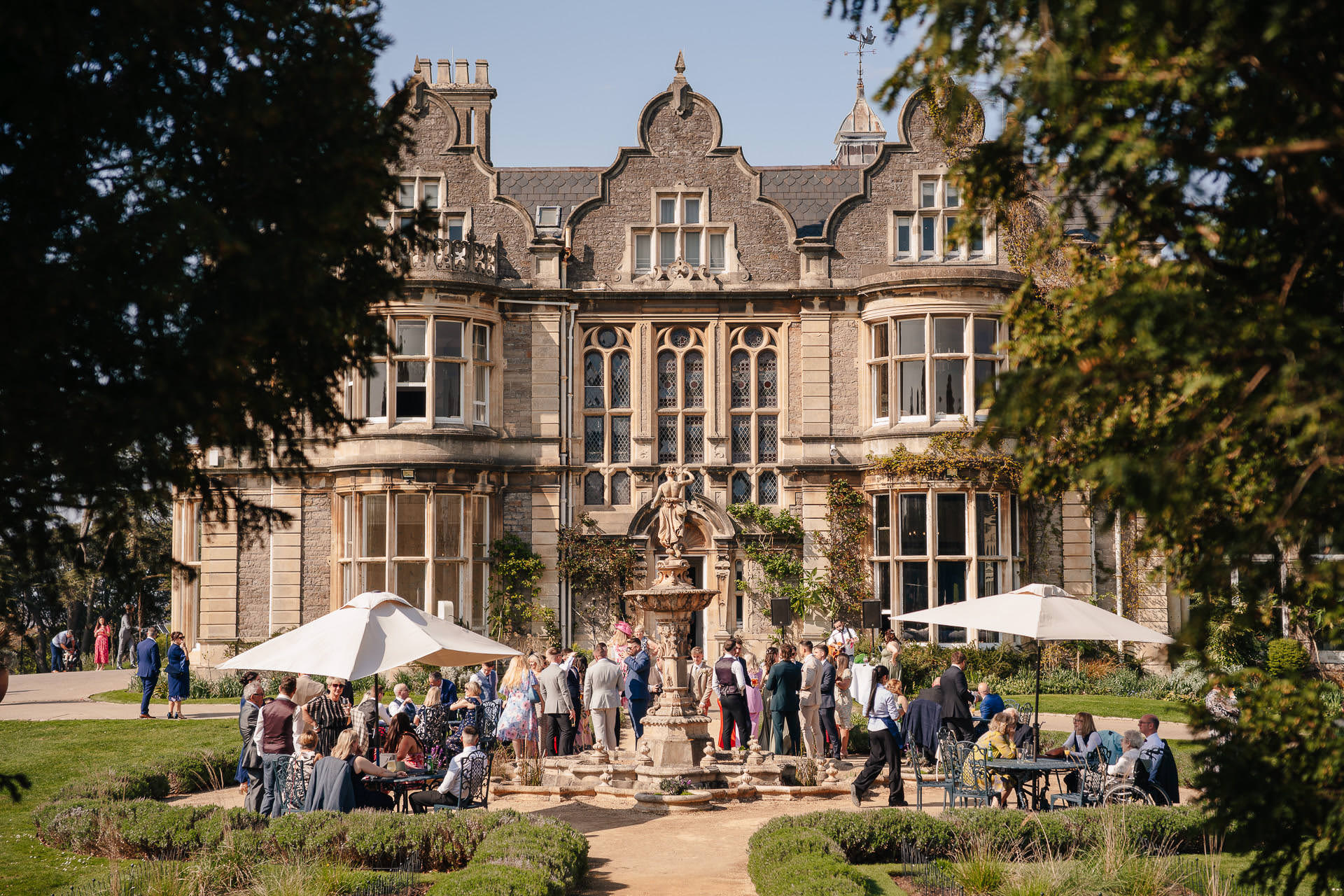
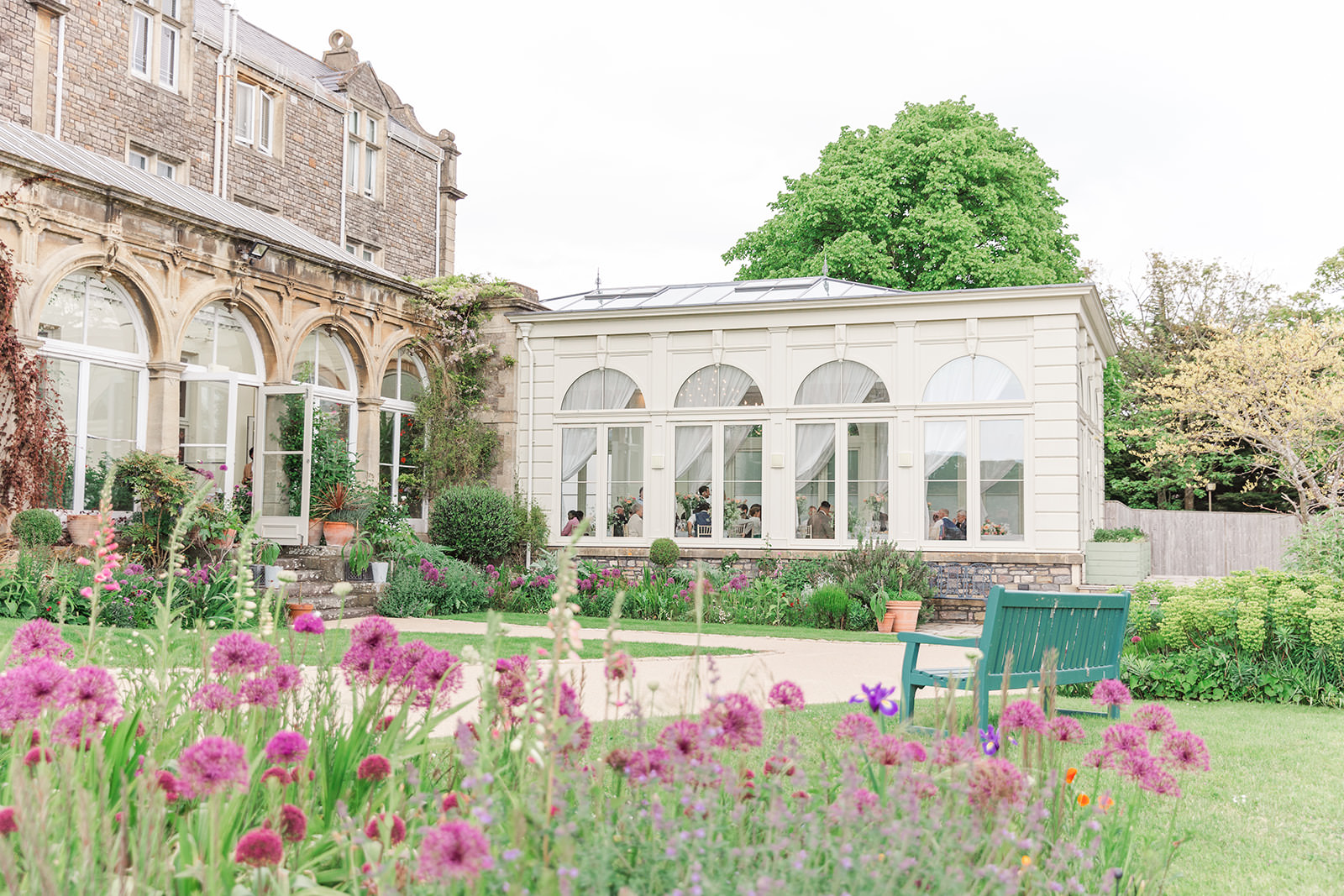
Clevedon Hall is a Grade II* listed Victorian house of 1853, on the edge of Clevedon in North Somerset, looking out over the water. It is 15 miles from Bristol, with Bristol Airport 20 minutes away. Weddings take the house exclusively, and all catering is cooked on site by our own kitchen.
Our published exclusive-use hire rates are mid-week rates, and they run by season:
- January and February, from £5,500
- March, April, October, November and December, from £7,600
- May to September, from £9,650
Minimum food and beverage spends apply and vary with season and guest numbers, so treat the hire figure as one part of the total rather than the total. Full detail sits on our wedding investment page.
Two things in that hire are worth drawing out for anyone thinking about a mid-week wedding. The cottage is included the night before, with continental breakfast for up to eight, which is where most couples put the people who need to be on site early. And the house is yours from eleven in the morning, which gives suppliers a proper set-up window. For the full two-night version described earlier in this guide, multi-day hire is available at £5,000 per additional day.
Lauren England and the wedding team take viewings most weekdays, which has the incidental advantage of showing you the house on the sort of day you would be marrying on.
Sources
- Bridebook, UK Wedding Report 2026: https://partners.bridebook.com/uk/wedding-report-2026
- Hitched, Wedding Industry Report 2026 (reported by The Knot Worldwide): https://www.theknotww.com/press-releases/the-average-cost-of-a-wedding-in-2026-around-21990-according-to-hitched
- CompareWeddingInsurance.org.uk, average cost of a UK wedding 2026: https://www.compareweddinginsurance.org.uk/blog/average-cost-uk-wedding.php
- Rock My Wedding, guide to weekday weddings: https://rockmywedding.co.uk/wedding-planning/weekday-weddings
- Coco Wedding Venues, things to consider when planning a midweek wedding: https://cocoweddingvenues.co.uk/the-blog/planning/things-to-consider-when-planning-a-midweek-wedding/
- North Somerset Council, registrar and register office fees: https://n-somerset.gov.uk/my-services/births-marriages-deaths/registrar-fees-charges/registrar-register-office-fees
- GOV.UK, marriages and civil partnerships, giving notice: https://www.gov.uk/marriages-civil-partnerships/give-notice
- General Register Office, guidance on approved premises: https://assets.publishing.service.gov.uk/government/uploads/system/uploads/attachment_data/file/440072/ApprovedPremisesGuideIssue5.pdf
- Clevedon Hall, wedding investment and pricing: https://www.clevedonhall.co.uk/wedding-investment
More Wedding Inspiration


.svg)


